Finance automation vs. finance expertise: Where should you draw the line?
Finance teams have never had access to more technology than they do today.
Cloud accounting software, automated workflows, artificial intelligence (AI), and digital reporting tools have changed the way businesses manage their finances. Tasks that once took hours can now be completed in minutes. Transactions can be processed automatically, reports generated instantly, and approvals completed with just a few clicks.
These improvements have helped businesses become more efficient. They have also raised an important question.
If technology can complete so many finance tasks, how much does a business still need finance expertise?
It is a fair question, but it starts with the wrong assumption.
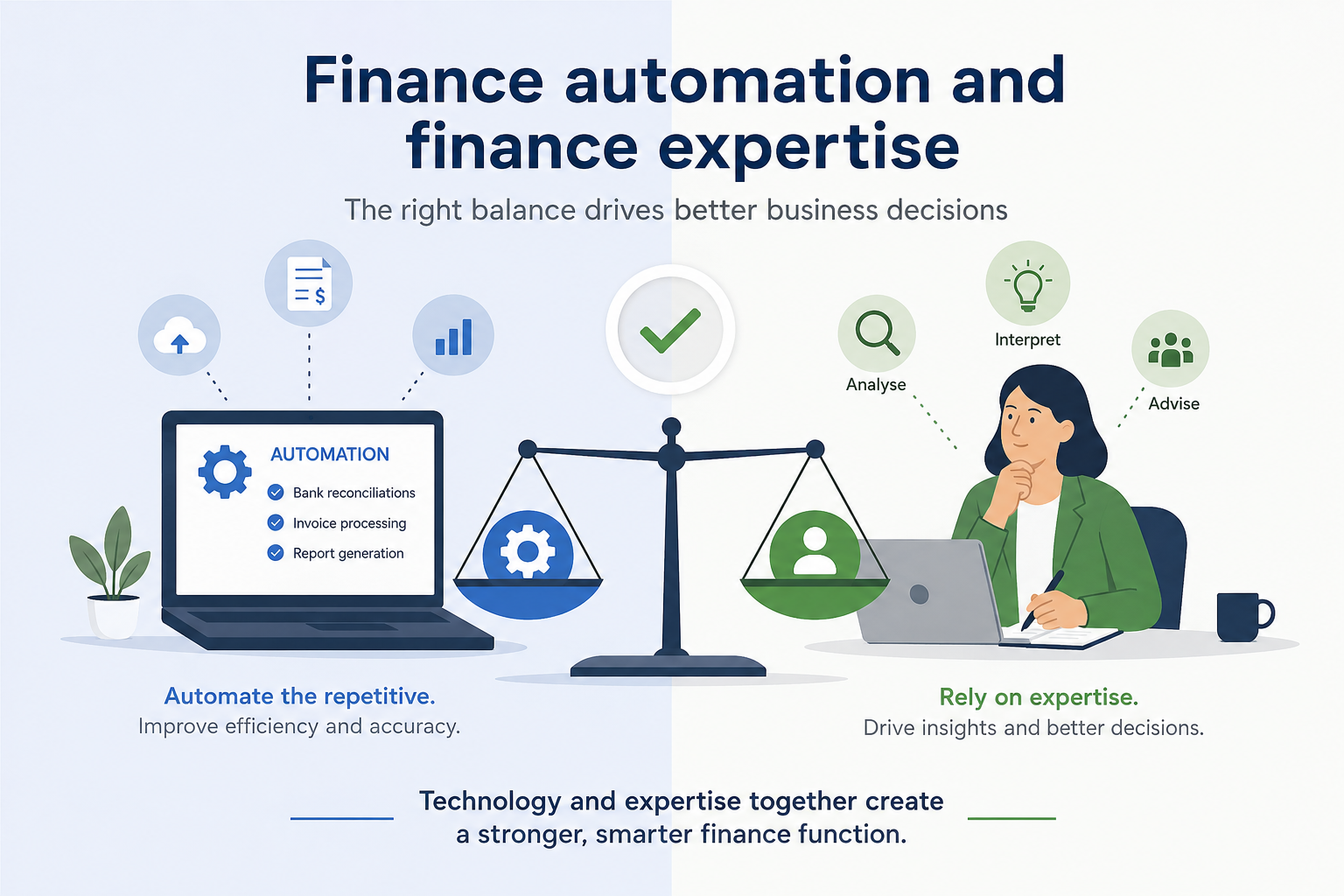
Automation and finance expertise are not competing with each other. They solve different problems. Automation helps businesses work faster. Finance professionals help businesses work smarter.
Knowing where to draw the line between the two is one of the most important decisions a growing business can make.
The rise of finance automation
Most businesses already use some form of finance automation, even if they do not think about it that way.
Bank transactions can flow directly into accounting software. Recurring transactions can be processed automatically, payroll calculations can be completed more efficiently, bank reconciliations can take less time, and standard financial reports can be generated almost instantly.
These systems reduce the amount of manual work finance teams complete each day.
Instead of entering the same information repeatedly, employees can spend more time reviewing results and managing exceptions.
For businesses processing hundreds or even thousands of transactions each month, this creates significant time savings.
Automation also improves consistency. When the same process follows the same rules every time, businesses are less likely to experience the simple mistakes that often occur with manual data entry.
That is why finance automation has become a standard part of modern business operations.
Where automation delivers the greatest value
Automation works best when a task is repetitive, predictable, and follows clear rules.
These are the tasks that consume time without requiring critical thinking.
Examples include:
- Importing bank transactions
- Matching invoices with payments
- Processing recurring invoices
- Completing bank reconciliations
- Running payroll calculations
- Managing approval workflows
- Producing routine financial reports
- Storing financial documents
By automating these tasks, finance teams can complete routine work more efficiently while improving consistency across the business.
This does not remove the need for finance professionals. Instead, it gives them more time to focus on work that technology cannot do well.
Finance is about more than processing transactions
Processing transactions is only one part of finance.
The real value comes from understanding what the numbers mean.
A finance system can identify that expenses increased by 15 per cent last month.
A finance system can show that operating costs increased during the month. It cannot explain what caused the increase, whether it is a one-off issue, or what the business should do next.
A dashboard can highlight declining cash flow.
It cannot determine what the results mean for the business or what actions should be taken next.
Technology presents information.
Finance professionals interpret it.
That difference becomes even more important as a business grows.
Business decisions still depend on human judgement
Every important financial decision involves context.
- Should the business invest in new equipment?
- Can it afford to hire more employees?
- Is a new location financially viable?
- Should prices increase?
- Can cash flow support future growth?
These questions cannot be answered by software alone.
Technology provides the data, but experienced finance professionals apply commercial understanding, industry knowledge, and practical experience before making recommendations.
Numbers rarely tell the whole story on their own.
Understanding why something happened is often far more valuable than simply knowing that it happened.
Automation is only as good as the information it receives
One of the biggest misconceptions about automation is that it automatically improves accuracy.
In reality, automation depends on accurate information.
If incorrect data enters a finance system, automation will continue processing that information unless someone identifies the problem.
An incorrectly coded transaction can affect financial reporting. Incorrect payroll settings can produce inaccurate employee payments. Reconciliation errors can reduce confidence in financial information. These issues are not caused by automation itself. They occur when inaccurate information enters the process or errors go unnoticed. Regular review by experienced finance professionals helps identify and correct these issues before they affect reporting, compliance, or business decisions.
Automation improves efficiency.
People protect accuracy.
Compliance still needs professional oversight
Finance teams do much more than keep records.
They also help businesses meet their tax, payroll, and financial reporting obligations.
Laws, regulations, and reporting requirements change over time. Businesses need to understand how those changes affect their financial processes.
Software can apply calculations and support compliance, but it cannot replace professional expertise.
Finance professionals review unusual transactions, assess complex situations, and ensure financial information accurately reflects the business.
This level of oversight becomes even more important as organisations expand, enter new markets, or introduce new products and services.
The strongest finance teams use both
Businesses sometimes view automation and finance expertise as an either-or decision. In reality, the strongest finance functions rely on both.
Automation is best suited to repetitive tasks where speed, consistency, and standardisation matter most. It reduces manual work, streamlines processes, and improves efficiency.
Finance professionals bring the skills that technology cannot. They analyse results, solve problems, maintain financial control, ensure compliance, and support better business decisions.
By removing routine administrative work, automation gives finance professionals more time to focus on important tasks. In turn, their expertise ensures the information produced is accurate, meaningful, and useful.
Together, automation and finance expertise create a finance function that is both efficient and reliable.
Where should businesses draw the line?
The answer will differ from one organisation to another, but one principle remains the same.
If a task follows the same process every time, automation is usually the right solution.
If a task requires judgement, investigation, interpretation, or business understanding, finance expertise should remain at the centre of the process.
Businesses achieve the best results when technology supports people rather than replaces them.
This approach allows finance teams to spend less time completing routine administration and more time helping the business improve performance.
Technology works best when experienced people are behind it
Technology will continue to transform finance. New software, automation tools, and AI capabilities will improve efficiency and reduce manual work across many finance processes.
However, successful businesses recognise that finance is not simply about producing numbers. It is about understanding those numbers, managing risk, maintaining accuracy, and supporting better decisions.
At Accario, we help businesses combine the benefits of finance automation with the knowledge of experienced finance professionals. Our teams work within your existing systems to support bookkeeping, finance operations, reporting, payroll, reconciliations, and back-office processes. By combining skilled people, structured processes, and technology-enabled workflows, we help businesses improve efficiency without compromising accuracy, compliance, or financial oversight. The result is a finance function that is built not only for today’s workload, but also for tomorrow’s growth.
Technology can make finance faster. The right expertise makes it better. Contact us today to learn how we can help you build a finance function that delivers both.
Follow Us


Most Popular


Are you ready
to get your time
back?
Yes! Accario will help you
focus on your business
More smarts, more efficiencies,
with more benefits.