The Modern Accountant’s Checklist
Accounting has never been just about numbers. It is about trust, precision and the ability to turn financial information into meaningful insight. As businesses continue to evolve, accountants have evolved from bookkeepers into strategic partners, shaping decisions, driving efficiency, and ensuring compliance.
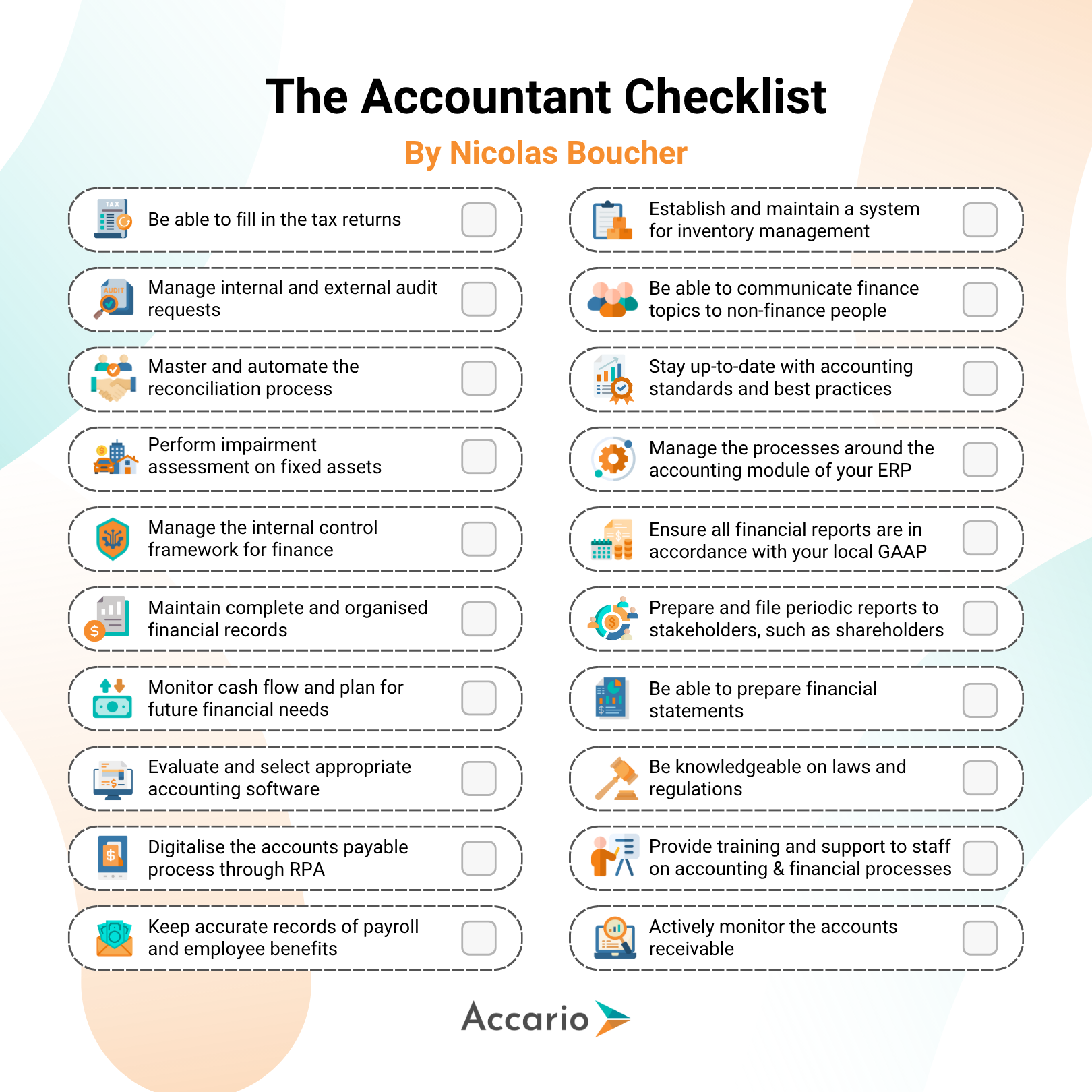
Inspired by The Accountant Checklist by Nicolas Boucher, here is what defines a truly complete accountant in 2025, someone who blends technical mastery, digital fluency and business understanding to deliver lasting value.
From tax returns to true compliance
It starts with the basics, being able to fill in tax returns accurately and on time. But accuracy alone is not enough anymore. The modern accountant needs to understand the logic behind each filing, anticipate upcoming legislative changes, and guide businesses toward smarter tax strategies.
Audits are another constant in the accounting world. Managing both internal and external audit requests requires organisation, transparency, and clear communication with stakeholders, whether it is meeting the rigorous standards of UK GAAP or adhering to Australian Accounting Standards (AAS).
Compliance does not stop there. Accountants must stay knowledgeable on laws and regulations, perform impairment assessments on fixed assets, and ensure periodic reports are filed correctly to shareholders and regulatory authorities. These actions demonstrate integrity, the quality that underpins every successful finance professional.
Automate, integrate, and innovate
Modern accounting teams are powered by technology. Automation of the reconciliation process has become essential, saving time and minimising human error. Accountants who can master these automated tools are not just efficient, they are built for the modern workplace.
Equally important is managing the processes around the accounting module of an ERP system. Understanding how the system connects different financial functions, from procurement to reporting, helps maintain accuracy and speed.
Innovation also means embracing digital transformation across everyday tasks. From digitalising the accounts payable process through RPA to evaluating and selecting appropriate accounting software, accountants now play a central role in technology adoption. They ensure systems talk to each other seamlessly, eliminating silos and enabling instant financial insights.
Inventory and payroll management also benefit from this transformation. Establishing and maintaining a system for inventory management ensures assets are accurately tracked and valued. Meanwhile, keeping precise records of payroll and employee benefits is critical for compliance, staff trust, and long-term planning.
The core of financial control
Behind every strong business is a well-governed finance function. Managing the internal control framework for finance protects the organisation from fraud, errors, and inefficiencies. This framework also supports the ability to maintain complete and reliable financial records, which are the foundation for accurate reporting.
Cash flow is another cornerstone of good governance. Accountants who monitor cash flow and plan for future financial needs help ensure business continuity and resilience. From forecasting revenue to anticipating expenses, their insights guide operational and investment decisions.
Staying up to date with accounting standards and best practices further enhances this control. Standards evolve and those who keep learning stay ahead of regulatory expectations and client needs.
People, process, and purpose
While technology handles much of the heavy financial work, people skills still set great accountants apart. Being able to communicate finance topics to non-finance people, in clear, practical language, turns complex data into useful knowledge.
Providing training and support to other staff on accounting and financial processes builds stronger teams and a culture of collaboration. When everyone understands how their work affects the company’s financial health, the entire organisation benefits.
Preparing financial statements and periodic reports to shareholders is another vital skill. These reports tell the story of the business’s performance and stability. Accountants who can prepare them accurately and interpret the results add real strategic value.
Active monitoring of accounts receivable also plays an essential part in maintaining healthy cash flow. It is not just about collecting what is owed, it is about understanding patterns, preventing delays and supporting the overall liquidity of the business.
The strategic edge of modern accounting
Today’s accountants are not just historians of numbers; they are architects of future success. Evaluating new accounting systems, optimising workflows, and managing technology integrations all contribute to building a finance function that supports growth.
Equally, they help organisations stay resilient by ensuring all financial processes, from payroll to inventory and cash flow, work together seamlessly. The accountant’s checklist is no longer just about ticking boxes, it is a blueprint for operational excellence.
In the end, great accounting is not just about reporting what happened. It is about shaping what happens next.
Follow Us


Most Popular


Are you ready
to get your time
back?
Yes! Accario will help you
focus on your business
More smarts, more efficiencies,
with more benefits.