The balance between automation and human expertise in business
Businesses are under constant pressure to operate more efficiently while keeping costs under control.
At the same time, workloads are increasing, compliance requirements are becoming more demanding, and customers expect faster service. Businesses often expect teams to deliver more without significantly increasing headcount.
To meet these demands, many organisations are turning to automation.
From finance and payroll to administration and reporting, technology can streamline repetitive tasks, reduce manual effort, and improve consistency. It helps businesses process information more efficiently and support growth.
However, automation is not a complete solution.
The challenge is not deciding whether to automate. It is deciding where technology adds value and where human expertise remains essential.
Many businesses assume technology alone can solve operational challenges, but the reality is more complex.
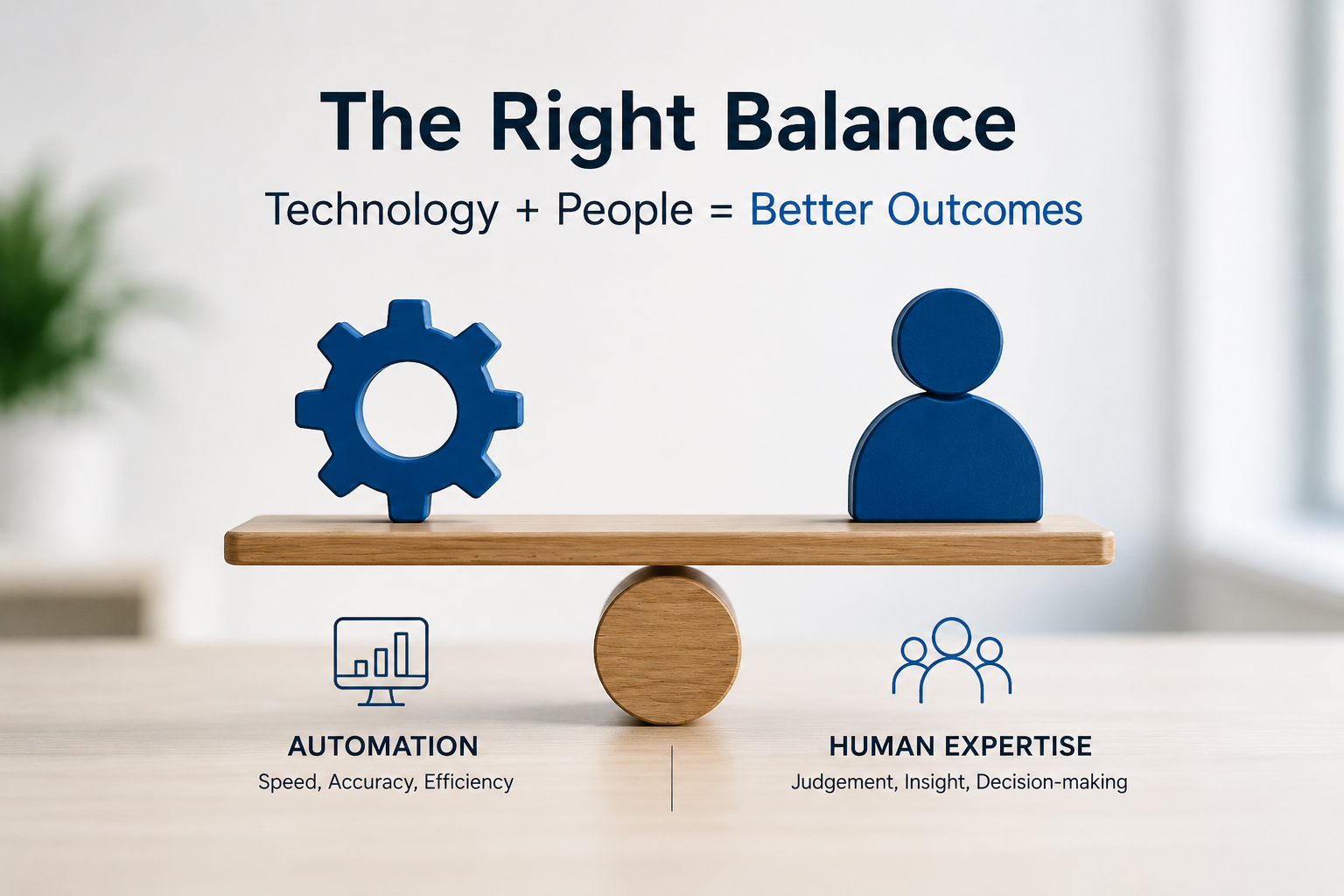
The most successful organisations combine automation with human expertise. They use technology to handle routine tasks while relying on experienced professionals to make decisions, solve problems, and provide strategic guidance.
As businesses look for ways to improve efficiency without compromising quality, finding the right balance between technology and people has never been more important.
Why automation has become a business priority
The appeal of automation is easy to understand.
Many business processes involve repetitive activities that follow the same steps every day. Data entry, invoice processing, reconciliations, report generation, payroll calculations, and workflow approvals are just a few examples.
These tasks consume valuable time when completed manually.
Automation allows businesses to process large volumes of work more efficiently. It reduces the need for repetitive administrative effort and helps create more consistent outcomes.
In finance operations, automation can speed up invoice processing, automate transaction matching, and streamline reporting.
In payroll, it can calculate wages, taxes, superannuation, and leave entitlements more efficiently.
In bookkeeping, automation can reduce manual processing and provide greater visibility over financial information.
These improvements allow businesses to focus resources on higher-value activities while maintaining productivity as workloads increase.
However, efficiency alone does not guarantee accuracy or good decision-making.
Where automation reaches its limits
Technology works best when businesses use clear and predictable processes.
It follows rules. It completes the tasks people set for it. Consistent rules and processes help it deliver reliable results.
Business operations, however, are not always predictable.
Exceptions occur every day.
Client information may be incomplete. Transactions may require investigation. Employees may have unique payroll arrangements. Financial data may contain unusual items that require further review.
Technology can identify these situations, but it cannot always determine the best response.
For example, an automated accounts payable workflow can process hundreds of invoices efficiently. However, when information is incomplete or transactions fall outside standard parameters, someone still needs to investigate and resolve the issue.
The same applies to bookkeeping. Software can process transactions automatically, but experienced professionals often identify inconsistencies, coding errors, and unusual transactions that require further review.
Payroll systems can calculate employee payments, but experienced professionals still manage changing requirements and employee-specific circumstances.
Automation supports the process. Human expertise protects the outcome.
The risk of removing people from the process
As businesses invest in technology, some make the mistake of viewing automation as a replacement for people rather than a tool that supports them.
This approach can create operational risk.
When businesses rely too heavily on automation, mistakes can go unnoticed for longer. If businesses use incorrect data or fail to update their systems, automation can continue producing inaccurate results.
Technology cannot always recognise when business circumstances change.
People can.
Experienced professionals understand context. They recognise when something does not look right. They ask questions. They investigate unusual results. They identify opportunities for improvement.
These capabilities remain critical in areas such as finance, payroll, compliance, and operational reporting.
While technology can process information, people remain responsible for the outcomes.
This becomes even more important as businesses expand and operations become more complex.
Human expertise creates business value
Technology helps businesses work faster.
People help businesses work smarter.
Experienced professionals bring a level of judgement that software cannot replicate.
They understand business objectives, operational risks, customer requirements, and regulatory obligations. They assess information in context and make informed decisions when there is no clear rule to follow.
Human expertise also plays a critical role in improving the effectiveness of automation itself.
People design processes, review results, identify issues, and look for ways to improve how teams perform their work.
Without people reviewing and managing the process, even advanced technology cannot perform at its best.
This is particularly important in finance and accounting functions where accuracy directly affects business performance.
Technology can generate financial reports automatically, but business leaders still rely on experienced professionals to interpret the information and identify what requires action.
A payroll system may process employee payments, but skilled payroll specialists help businesses meet compliance obligations and resolve issues quickly.
Technology provides the data. People provide the insight.
The strongest operations use both
The most effective businesses do not choose between automation and human expertise.
They combine both.
Automation handles repetitive, high-volume tasks that benefit from speed and consistency.
People focus on decision-making, quality control, exception management, process improvement, and customer support.
This creates a stronger operating model.
Work is completed more efficiently, quality remains high, and teams spend more time on activities that support business growth.
The result is not simply increased productivity.
It creates a stronger operation that can adapt to changing business needs and continue delivering consistent results.
Why the right balance matters in finance operations
Finance operations are a good example of why businesses need both technology and people.
Many businesses use automation for bookkeeping, payroll, accounts payable, reconciliations, reporting, and other finance tasks.
This can save time, improve efficiency, and reduce manual work.
However, these activities still require accuracy, compliance, and human review.
While automation can process information quickly, it cannot always identify issues, understand changing requirements, or provide business advice.
This is why successful businesses combine technology with experienced finance professionals.
Together, they help businesses improve efficiency without compromising quality.
How Accario helps businesses achieve the right balance
At Accario, we help businesses and accounting firms manage finance operations more efficiently through a combination of experienced people, proven processes, and modern technology.
We support organisations across bookkeeping, payroll, accounts payable, reconciliations, SMSF administration, and professional services, helping them reduce administrative workload, improve visibility, and create capacity for growth.
By combining experienced teams, structured processes, and modern technology, we help businesses improve visibility, maintain quality, and reduce the burden of day-to-day finance administration.
This gives business owners and accounting firms more time to focus on their clients, customers, and growth.
Because the goal is not simply to automate work.
It is to create operations that are efficient, reliable, and supported by the right people, processes, and technology.
Looking for a smarter way to manage your operations? Contact us to learn how we help businesses improve efficiency, strengthen financial visibility, and create more time to focus on growth.
Follow Us


Most Popular


Are you ready
to get your time
back?
Yes! Accario will help you
focus on your business
More smarts, more efficiencies,
with more benefits.