The risk management process: a simple guide for businesses
Every business faces risk.
Some risks are obvious, such as economic uncertainty, cybersecurity threats, regulatory changes, or operational disruptions. Others can develop quietly over time and create challenges when they are least expected.
While risks cannot always be eliminated, they can be managed. This is where a structured risk management process becomes important.
Risk management helps businesses identify potential threats, understand their impact, and take practical steps to reduce exposure. Instead of waiting for problems to arise, businesses can make informed decisions that protect their operations, people, reputation, and long-term goals.
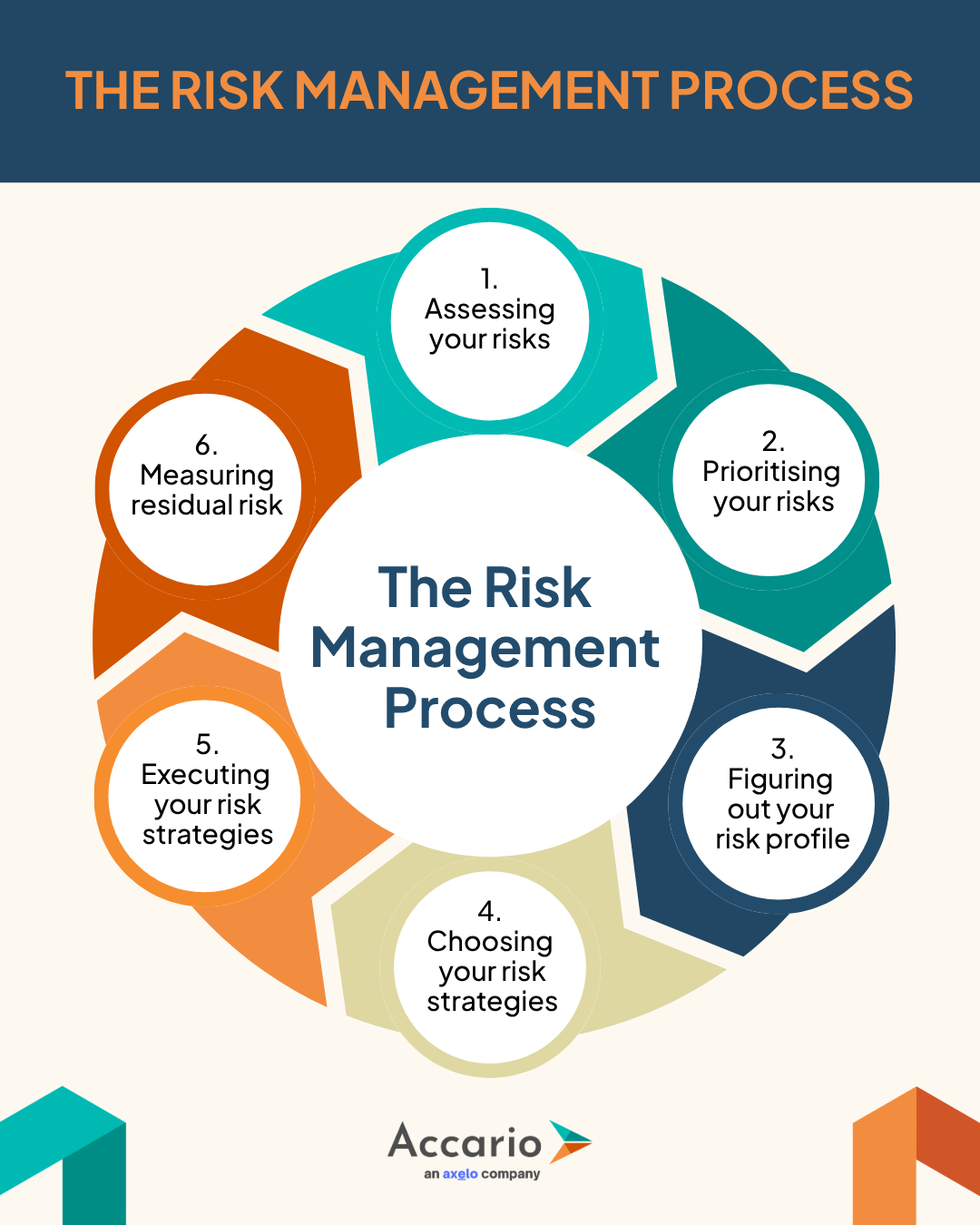
The risk management process typically follows six key stages.
1. Assessing your risks
The first step is identifying the risks that could affect your business.
These risks may come from both internal and external sources. Examples include:
- Cybersecurity threats
- Compliance failures
- Financial risks
- Staff turnover
- Technology failures
- Reputational damage
- Market changes
The goal is to create a clear picture of the risks that exist across the organisation.
At this stage, businesses often gather input from different teams, review past incidents, analyse industry developments, and examine areas where vulnerabilities may exist.
You cannot manage a risk that has not been identified, which is why assessment forms the foundation of the entire process.
2. Prioritising your risks
Not all risks carry the same level of importance.
Some risks may have a low likelihood of occurring and cause minimal disruption if they do. Others may have serious consequences for business operations, finances, customers, or regulatory compliance.
Once risks have been identified, they should be prioritised based on factors such as:
- Likelihood of occurrence
- Potential financial impact
- Operational consequences
- Regulatory implications
- Reputational damage
Many organisations use a risk matrix to evaluate and rank risks according to severity and probability.
Prioritisation allows businesses to focus their resources on the areas that present the greatest threat rather than attempting to address every risk equally.
3. Figuring out your risk profile
After risks have been prioritised, businesses need to understand their overall risk profile.
A risk profile provides a broader view of how exposed the organisation is to different types of risk.
This stage helps answer important questions such as:
- Which risks pose the greatest threat to business objectives?
- How much risk is the organisation willing to accept?
- Are there areas where risk exposure is increasing?
- Are current controls sufficient?
Understanding the risk profile helps leaders make informed decisions about where resources, controls, and investments should be directed.
It also creates greater visibility for management teams and stakeholders by providing a clearer understanding of the organisation’s risk landscape.
4. Choosing your risk strategies
Once risks have been evaluated, the next step is deciding how they will be managed.
There are several common approaches to risk treatment:
Avoid
In some situations, the best option may be to avoid the activity that creates the risk altogether.
For example, a business may choose not to enter a high-risk market or discontinue a service that creates excessive exposure.
Reduce
Many risks can be reduced through stronger controls, improved processes, staff training, or technology solutions.
For example, implementing multi-factor authentication can reduce cybersecurity risks.
Transfer
Some risks can be transferred to another party.
Insurance is one of the most common examples, allowing businesses to transfer part of the financial impact of certain events.
Accept
Not every risk requires action.
If a risk is low in likelihood and impact, the business may decide to accept it while continuing to monitor the situation.
Selecting the right strategy depends on the nature of the risk, available resources, and the organisation’s risk appetite.
5. Executing your risk strategies
A risk strategy only creates value when it is implemented effectively.
This stage involves putting chosen actions into practice across the organisation.
Examples may include:
- Updating policies and procedures
- Introducing new technology controls
- Conducting staff training
- Strengthening governance frameworks
- Improving reporting processes
- Implementing monitoring systems
Successful execution often requires collaboration across multiple departments.
Clear communication is also important. Employees need to understand their responsibilities and how their actions contribute to reducing risk.
Without effective implementation, even the best risk management plans can fail to deliver results.
6. Measuring residual risk
After controls and strategies have been implemented, businesses must evaluate what level of risk remains.
This remaining exposure is known as residual risk.
No control is perfect, and very few risks can be completely eliminated. The objective is to reduce risks to an acceptable level rather than remove them entirely.
Measuring residual risk helps businesses determine:
- Whether controls are working effectively
- Whether additional action is required
- Whether risk levels remain within acceptable limits
- How risk exposure changes over time
Regular reviews ensure that risk management remains effective as the business environment evolves.
Risk management is an ongoing process
One of the most important things to understand about risk management is that it is not a one-time activity.
Business environments change constantly. New technologies emerge, regulations evolve, customer expectations shift, and new threats appear.
A risk management framework should therefore be reviewed regularly to ensure it remains relevant and effective.
By continually assessing risks, prioritising threats, reviewing risk profiles, implementing strategies, and monitoring outcomes, businesses can build greater resilience and make more confident decisions.
Risk is a natural part of doing business, but unmanaged risk can create significant challenges.
A structured risk management process provides a practical framework for identifying potential threats, understanding their impact, and taking action before problems arise.
By following the six stages of risk management, assessing risks, prioritising risks, understanding the risk profile, choosing strategies, executing actions, and measuring residual risk, businesses can strengthen decision-making, improve resilience, and better protect their long-term success.
Because effective risk management is not about avoiding risk entirely. It is about understanding it, preparing for it, and managing it with confidence.
Follow Us


Most Popular


Are you ready
to get your time
back?
Yes! Accario will help you
focus on your business
More smarts, more efficiencies,
with more benefits.