Kaizen’s 7-step approach: A practical framework for continuous improvement
Every business wants to improve. The challenge is knowing where to start.
Many organisations focus on fixing problems only after they become serious. By then, the issue may have already affected clients, employees, productivity, or profitability. A better approach is to make improvement part of everyday operations.
This is the idea behind Kaizen, a proven approach that encourages continuous, small improvements rather than waiting for major changes. Instead of trying to transform everything at once, Kaizen helps businesses identify opportunities, solve problems systematically, and build better processes over time.
What is Kaizen?
Kaizen is a Japanese philosophy that means continuous improvement.
Rather than relying on one-off projects or large-scale change initiatives, Kaizen focuses on making small, practical improvements consistently. Over time, these improvements can have a significant impact on productivity, quality, client satisfaction, and business performance.
One of the strengths of Kaizen is that improvement is everyone’s responsibility. Ideas do not only come from managers. Employees who perform the work every day often have the best understanding of where processes can be improved.
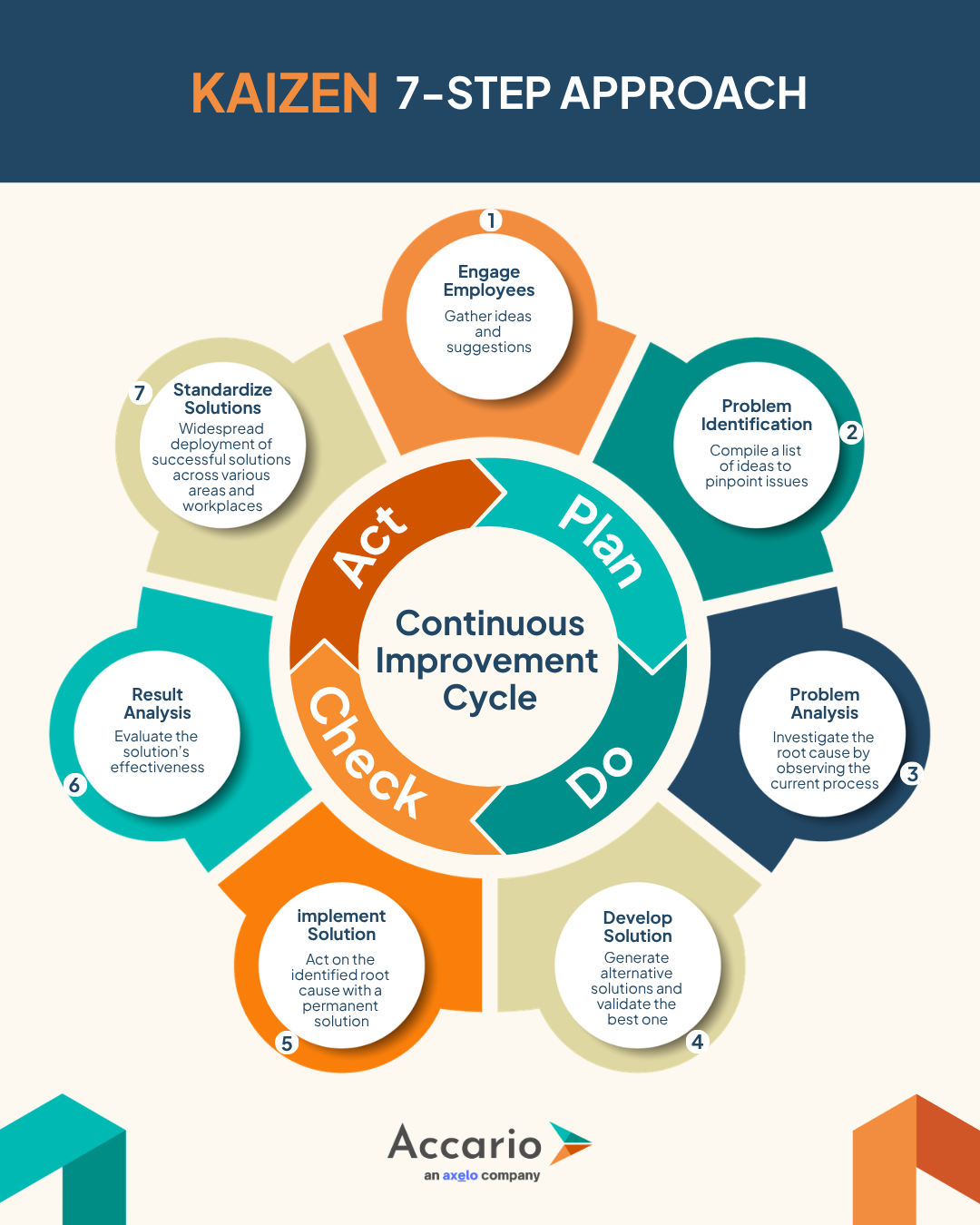
The Kaizen approach follows a continuous cycle of:
Plan → Do → Check → Act
This cycle helps businesses test improvements, measure results, and make successful changes part of normal operations.
The Kaizen 7-step approach
1. Engage employees
Every improvement begins with listening.
Employees work with business processes every day. They often notice delays, repetitive tasks, communication gaps, or unnecessary manual work long before management does.
Encouraging staff to share ideas creates a culture where improvement becomes part of everyday work rather than an occasional project.
Questions to ask include:
- What tasks take longer than they should?
- What causes frustration?
- Where do errors happen most often?
- Which manual tasks could be simplified?
Small suggestions can often lead to meaningful improvements.
2. Identify the problem
Before finding a solution, clearly define the problem.
Many organisations jump straight into fixing problems instead of understanding what is actually wrong.
For example:
Instead of saying: “Month-end reporting takes too long.”
Define the issue more clearly: “Bank reconciliations are delayed because transaction information arrives from multiple systems at different times.”
A clearly defined problem is much easier to solve.
3. Analyse the problem
Once the problem has been identified, investigate why it happens.
Avoid making assumptions.
Look at the current process carefully and identify the root cause rather than the visible problem.
Useful questions include:
- Where does the process slow down?
- Which step creates delays?
- Is information missing?
- Are responsibilities unclear?
- Is manual work causing errors?
Understanding the root cause prevents the same issue from happening again.
4. Develop the best solution
After identifying the cause, generate possible solutions.
There is rarely only one answer.
Consider several options before deciding which approach will deliver the best outcome.
When comparing solutions, think about:
- Cost
- Time required
- Ease of implementation
- Long-term benefits
- Impact on employees and customers
The goal is not simply to implement change. It is to implement the right change.
5. Implement the solution
Now it is time to put the chosen solution into practice.
Successful implementation requires planning and communication.
Everyone involved should understand:
- What is changing
- Why it is changing
- When the change will happen
- Who is responsible
Testing changes on a smaller scale before rolling them out across the business can reduce risk and make adjustments easier.
6. Evaluate the results
Once the solution has been implemented, measure the outcome.
Did the improvement solve the original problem?
Look at the data and gather feedback from employees involved in the process.
Useful measures may include:
- Faster processing times
- Fewer errors
- Improved customer satisfaction
- Reduced manual work
- Better reporting accuracy
If the results are not what you expected, review the process and make further improvements.
Continuous improvement means learning from every outcome.
7. Standardise successful solutions
When a solution works, make it part of your standard way of working.
Document the improved process, update procedures, and train employees so everyone follows the same approach.
Standardisation helps businesses:
- maintain consistency
- improve quality
- reduce errors
- train new employees more effectively
- build on future improvements
Without standardisation, businesses often return to old habits, and the benefits of improvement are lost.
Continuous improvement never stops
The Kaizen process does not end after step seven.
Once one improvement has been completed, businesses begin the cycle again.
Each improvement creates new opportunities to work more efficiently, improve quality, strengthen consistency, and deliver better outcomes.
Over time, these small improvements can transform how an organisation operates without the disruption of large-scale change projects.
Why continuous improvement matters
Business processes should evolve as an organisation grows. Without regular review, manual work increases, processes become inconsistent, and small inefficiencies can affect productivity and reporting accuracy.
Continuous improvement helps businesses:
- Improve operational efficiency
- Strengthen process consistency
- Improve the accuracy of financial and operational information
- Reduce manual effort
- Support better decision-making
- Build processes that can support future growth
By making continuous improvement part of everyday operations, businesses can identify opportunities earlier, solve problems more effectively, and create processes that remain reliable as the organisation evolves.
Continuous improvement is not about making constant change. It is about making better decisions, improving processes, and solving problems in a structured way. The Kaizen 7-step approach provides a practical framework that helps businesses identify opportunities for improvement, implement effective solutions, and build more efficient and consistent ways of working over time.
Follow Us


Most Popular


Are you ready
to get your time
back?
Yes! Accario will help you
focus on your business
More smarts, more efficiencies,
with more benefits.