Why consistency matters more than complexity in financial reporting
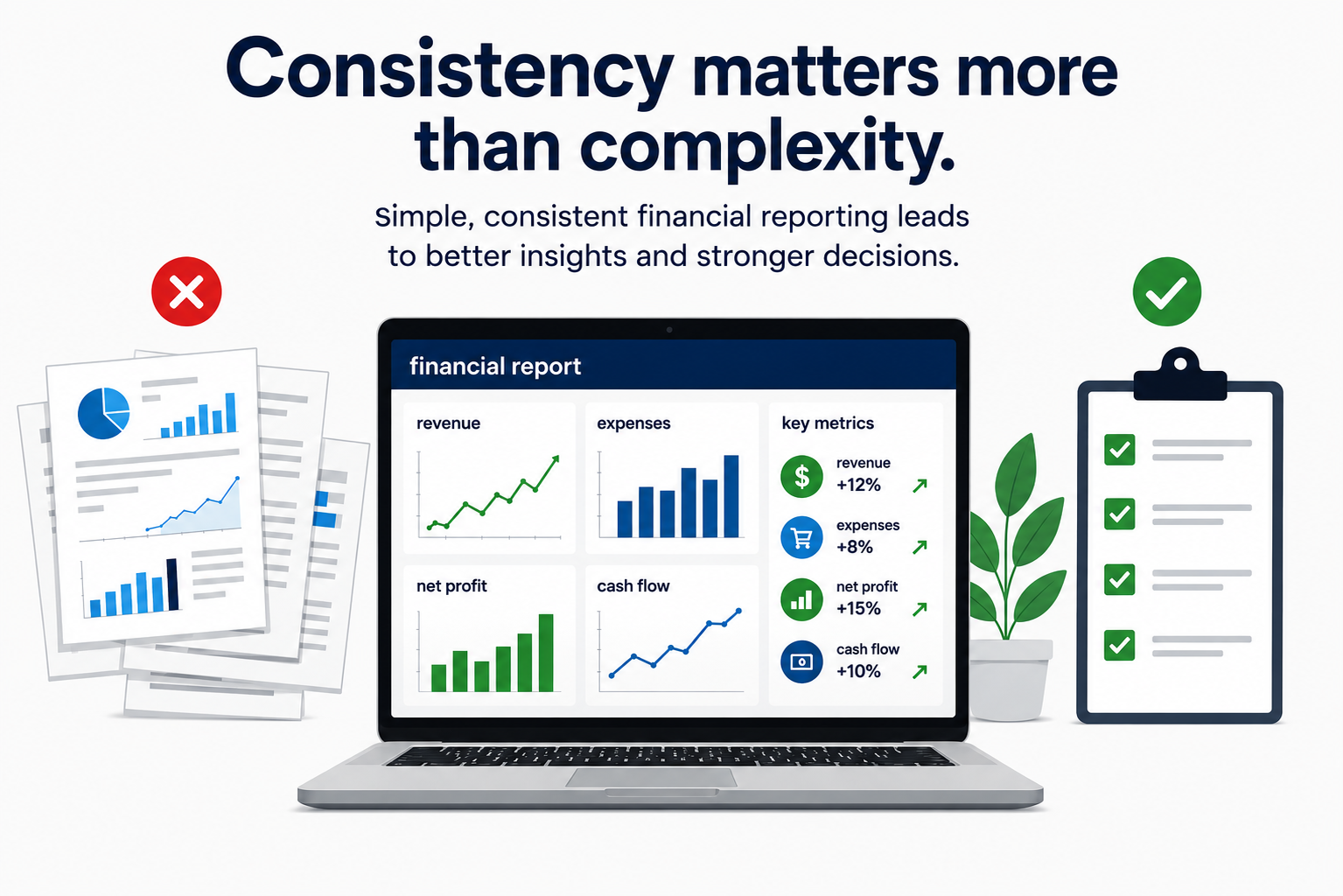
Financial reporting helps businesses understand their performance, manage resources, and make informed decisions. However, more detail does not always lead to better insights. Finance teams can spend significant time creating complex reports with too many charts, technical terms, and large amounts of data.
While these reports may appear impressive, they do not always help business leaders make faster or better decisions. In many cases, the opposite happens. When financial information is difficult to understand or changes from one reporting period to another, decision-making becomes slower and less effective.
Consistent financial reporting provides a better approach. Using the same format each reporting period makes it easier to compare results, identify changes in performance, and respond before small issues become bigger problems.
Businesses do not always need more reports. They need reports they can trust and use consistently.
The problem with overly complex financial reporting
Many growing businesses collect financial information from multiple departments, software platforms, and business locations. As the business expands, financial reports often become longer and more detailed, with additional metrics, calculations, and dashboards added over time. While the goal is to provide a more complete picture of business performance, overly complex reports can make financial information harder to understand and use.
Instead of helping leaders make faster decisions, complex reports often require more time to interpret. Different departments may calculate the same figures in different ways, creating inconsistencies and making it difficult to determine which numbers are accurate. When reports also vary in structure from one reporting period to the next, comparing performance becomes even more challenging.
As a result, financial reporting can become an administrative task rather than a practical decision-making tool. When business leaders cannot quickly understand their financial position, important decisions may be delayed. Opportunities can be missed, and emerging financial risks may not be identified until they have a greater impact on the business.
Why consistency creates better financial visibility
Consistent financial reporting means preparing financial information using the same structure, accounting methods, reporting periods, and performance measures every time.
This consistency allows businesses to compare results accurately over weeks, months, and years.
When reports follow a consistent format, decision-makers immediately know where to find important information. They spend less time searching for answers and more time evaluating business performance.
Consistency also helps businesses spot important changes that might otherwise be missed.
For example, if operating expenses increase over several months, consistent reporting makes the change easier to spot. Management can then identify the cause and take action before it affects profitability.
Without consistency, those same changes may be overlooked because each report presents information differently.
Better decisions depend on reliable information
Every business decision relies on financial information.
Whether hiring new employees, investing in equipment, expanding operations, or managing day-to-day expenses, leaders need confidence that the numbers accurately reflect business performance.
Reliable reporting builds that confidence.
When financial reports are prepared consistently, management knows the information is comparable from one reporting period to the next. This reduces uncertainty and allows decisions to be based on evidence rather than assumptions.
Even when financial results are not as strong as expected, consistent reporting helps businesses understand why performance changed and where improvements should be made.
Accurate information delivered consistently is far more valuable than complicated reports that create uncertainty.
Consistent reporting helps businesses identify changes earlier
Financial performance usually changes over time, not overnight. Rising costs, lower profit margins, cash flow challenges, and changes in revenue can develop gradually. Without consistent reporting, businesses may not notice these changes until they begin to affect performance.
Reviewing the same key financial indicators in a consistent format each reporting period makes it easier to track performance and identify changes as they happen. This gives business leaders the information they need to investigate unexpected results, make timely adjustments, and address potential issues before they have a greater impact.
By recognising changes early, businesses can make more informed financial decisions and plan more effectively for the future.
Clear reporting improves communication across the business
Financial reporting is not only for finance professionals.
Department managers, business owners, directors, and leadership teams all rely on financial information to support their responsibilities.
Reports that are overly technical or inconsistent can create communication gaps between finance teams and operational leaders.
Simple, consistent reporting helps everyone work from the same information.
When reports use familiar formats and clearly defined performance measures, discussions become more productive. Teams spend less time questioning the numbers and more time identifying practical actions.
This shared understanding also improves accountability, as everyone measures performance using the same financial information.
Consistency supports business growth
As businesses grow, financial reporting becomes increasingly important. More employees, expanding operations, additional business locations, and higher transaction volumes all make it more challenging to manage financial information accurately.
Without consistent reporting processes, businesses may experience reporting delays, inconsistent financial data, and unnecessary manual work. These challenges can make it harder for leaders to understand business performance and make timely decisions.
Establishing consistent financial reporting practices helps create a reliable foundation for growth. Using the same reporting structure and financial measures each reporting period makes it easier to compare performance, monitor progress, and identify areas that need attention.
Consistent reporting also improves the accuracy of financial information by reducing errors and ensuring reports are prepared using the same methods every time. As a result, business leaders can rely on their financial data when planning budgets, forecasting future performance, and making informed operational decisions.
As businesses continue to grow, consistent financial reporting helps ensure decision-makers have accurate, reliable information to support long-term success.
Simplicity makes financial reporting more useful
Many organisations believe financial reporting should include every available metric.
However, more information does not always create more value.
The most effective reports focus on the financial information that supports business decisions.
Clear income statements, balance sheets, cash flow reports, and relevant management reports often provide everything leaders need to understand business performance.
When reports remain focused, management can identify key messages quickly without becoming distracted by unnecessary detail.
Simple reporting also encourages regular review. Leaders are more likely to use reports that are easy to read than lengthy documents requiring extensive analysis.
Financial reporting should simplify decision-making, not complicate it.
Consistency builds long-term confidence
Financial reporting is most valuable when businesses can rely on it every reporting period.
Consistency creates confidence because decision-makers know the information follows the same standards each time.
Over months and years, this reliability strengthens financial planning, budgeting, forecasting, and performance reviews.
It also improves discussions with external stakeholders, including accountants, lenders, investors, and business advisers, who depend on accurate financial information to understand business performance.
Rather than questioning whether the reports are prepared correctly, everyone can focus on the insights the reports provide.
This gives business leaders greater confidence when planning for growth, managing costs, or making investment decisions.
Build better financial decisions with consistent reporting
Strong financial reporting is not measured by the number of pages in a report or the complexity of its dashboards. It is measured by how effectively it helps businesses understand their financial position and make informed decisions.
At Accario, we support businesses with bookkeeping, accounting, management reporting and Virtual CFO services that help provide accurate and timely financial information. Our experienced finance professionals help businesses maintain reliable financial records, understand performance and gain meaningful financial insights. With clear and consistent reporting, business leaders can monitor performance, identify important changes and make informed financial decisions, while spending more time focused on growing their business.
Make better financial decisions with consistent reporting. Contact us today to find out how our experienced finance professionals can help you improve financial reporting, gain reliable insights, and support smarter business decisions.
Follow Us


Most Popular


Are you ready
to get your time
back?
Yes! Accario will help you
focus on your business
More smarts, more efficiencies,
with more benefits.