Taxable Payments Annual Report (TPAR): due 28th August 2026
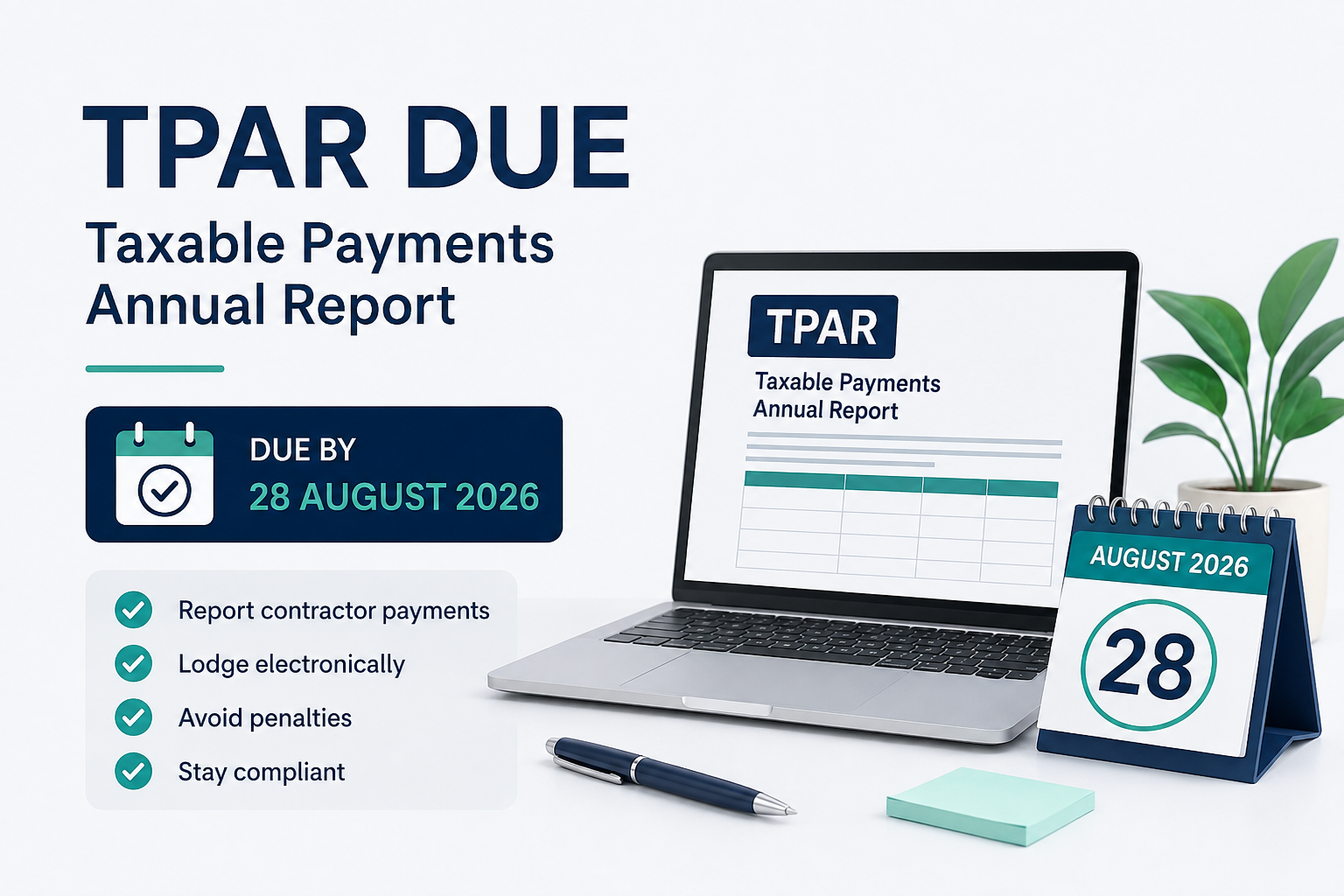
If your business provides certain services and pays contractors to provide those services on your behalf, there is an important deadline coming up.
The Australian Taxation Office (ATO) requires eligible businesses to lodge a Taxable Payments Annual Report (TPAR) by 28th August 2026. The report covers payments made to contractors between 1st July 2025 and 30th June 2026.
Missing the deadline can result in penalties for failing to lodge on time. Here is what you need to know about your reporting obligations.
What is the TPAR?
The Taxable Payments Annual Report forms part of the Taxable Payments Reporting System (TPRS).
Under the TPRS, certain businesses must report information about payments they make to contractors for specific services.
The ATO uses this information as a third-party data source. It can compare contractor payment information with other information reported to the ATO. This helps the ATO identify potential differences and support tax compliance.
Who needs to lodge?
The TPRS applies to businesses that provide certain services and pay contractors to provide those services on their behalf.
The covered services include:
- Building and construction
- Cleaning
- Courier and road freight
- Information technology (IT)
- Security, investigation or surveillance services
If your business provides one of these services and pays contractors for relevant work, you may need to lodge a TPAR.
However, the rules vary based on the payments you make. Some exemptions may also apply.
Contractor business structures
Contractors can operate as sole traders, companies, partnerships or trusts. The TPAR rules do not apply only to one type of business structure.
The rules can also apply to businesses that provide a mix of services.
For certain TPRS-covered services, a reporting exemption may apply when those services account for less than 10% of the business’s relevant GST turnover.
Your TPAR obligations depend on the services your business provides, the payments you make and any exemptions that apply.
Government entities
Government entities can also have TPRS reporting obligations.
Federal, state, territory and local government entities must report certain payments they make for services.
Federal, state and territory government entities must also report certain grants paid to people or organisations with an ABN. Local government entities do not need to report grants.
Not every contractor payment needs to be reported
You do not need to report every payment you make to a contractor.
The TPAR rules cover payments for relevant services under the TPRS. Certain payments and circumstances do not require reporting.
The key question is whether your business provides a covered service and hires a contractor to provide that service on your behalf.
If you are unsure whether you need to lodge a TPAR, check the ATO’s criteria or speak with your tax professional. Your obligations depend on the services you provide, the payments you make and any reporting exemptions that apply.
What has changed this year?
For the 2025 – 26 TPAR, you must lodge the report electronically.
You can lodge through Online services for business or use SBR-enabled software.
If a registered tax or BAS agent lodges the report for your business, they can use Online services for agents.
If you are unsure which option to use, check the ATO’s current lodgment options or speak with your registered tax or BAS agent.
If your business has a TPAR obligation, make sure you lodge by 28th August 2026.
What if you do not need to lodge?
If your business does not have a TPAR obligation for the 2025-26 financial year, you may need to submit a non-lodgment advice (NLA) instead of a full TPAR.
This may apply when your circumstances meet one of the reporting exemptions.
An NLA tells the ATO that your business does not need to lodge a TPAR for the relevant financial year. It can also help avoid unnecessary follow-up.
TPARs and NLAs are due by 28th August each year.
Getting ready to lodge
Start by gathering the key information for each contractor you paid for relevant services during the financial year.
You will generally need:
- Their Australian Business Number (ABN)
- Their name and address
- The total amount you paid them during the year
- The total GST included in those payments
The ATO may also ask for extra contractor information. This can include a contractor’s phone number, email address and bank account details.
Keep your contractor records and invoices up to date throughout the year. This makes it easier to find the information you need when preparing your TPAR.
Your accounting software may also support TPAR preparation or lodgment. If it does, you may be able to organise information from your existing records and reduce manual work before the deadline.
Do not leave it to the last minute
The 28th August deadline is approaching. If your business needs to lodge a TPAR, start preparing now.
Review your contractor payment records and invoices. Check the information you need for your report. Resolve any differences before you lodge.
Good record-keeping can make the process easier. It can also give you more time to deal with any issues before the deadline.
For full details on TPAR eligibility, reportable payments and lodgment options, check the ATO’s TPAR guidance. You can also speak with your accountant or registered tax agent about your specific obligations.
References
Australian Taxation Office (ATO) 2026, ‘Final reminder: TPAR due 28 August’, ATO, Available at: Final reminder: TPAR due 28 August
Follow Us


Most Popular


Are you ready
to get your time
back?
Yes! Accario will help you
focus on your business
More smarts, more efficiencies,
with more benefits.